BPC-157 is a peptide discussed in tissue-recovery research. Human pilot reports exist, but very small studies must be distinguished from established treatment outcomes.
BPC-157 attracts interest through questions about tissue responses and recovery. Alongside preclinical work, small human reports now provide material to examine. The key is to distinguish tissue repair, reported pain and tolerability: each answers a different question. [B1] [B2] [B3]
Key points worth knowing
- Uncontrolled human report — Some patients reported improvement in a retrospective report. Pain is not anatomical repair; intra-articular results do not validate tablets [B2]
- Two-person IV pilot — A pilot monitored short-term markers. No detected abnormalities cannot establish general safety [B3]
- Preclinical — Tendon-repair questions have been studied in rats. A basis for research, not established human treatment [B1]
Key findings and evidence
| Topic | Finding | Evidence | Limits |
|---|---|---|---|
| Knee pain | Some patients reported improvement in a retrospective report [B2] | Uncontrolled human report | Pain is not anatomical repair; intra-articular results do not validate tablets |
| Tolerability | A pilot monitored short-term markers [B3] | Two-person IV pilot | No detected abnormalities cannot establish general safety |
| Tendon research | Tendon-repair questions have been studied in rats [B1] | Preclinical | A basis for research, not established human treatment |
How large is the cited human study?
A 2025 pilot assessed two people who had previously received the substance. It reported no short-term abnormalities in the measured markers. It did not test treatment of torn tendons or muscles. Reference: BPC157 human pilot safety study (2025)
Which benefits still need demonstration?
No observed events in two people cannot establish general safety or faster return to sport. Comparative trials need to measure healing, function and adverse outcomes.
What if an injury prompted interest?
Clarify the diagnosis and recovery goal: less pain, improved movement or return to training. These outcomes differ from laboratory biomarkers and need appropriate assessment.
Frequently asked questions
Is there no human research at all?
That is too absolute. Small, limited human pilot reports exist.
Does reported tolerability prove tendon repair?
No. Tolerability and tendon-treatment efficacy are separate questions.
How should this article be used?
Use it to identify the substance, understand what the cited research measured, and prepare questions for a qualified clinician. It is educational information, not an individual treatment plan.
Oral BPC-157: label wording and evidence are different
SA BPC157500 and 500 mcg below are transcribed from the supplied source image for label explanation. They are not product-test results or directions for use. A substance name and a number do not establish that research findings apply to this formulation.
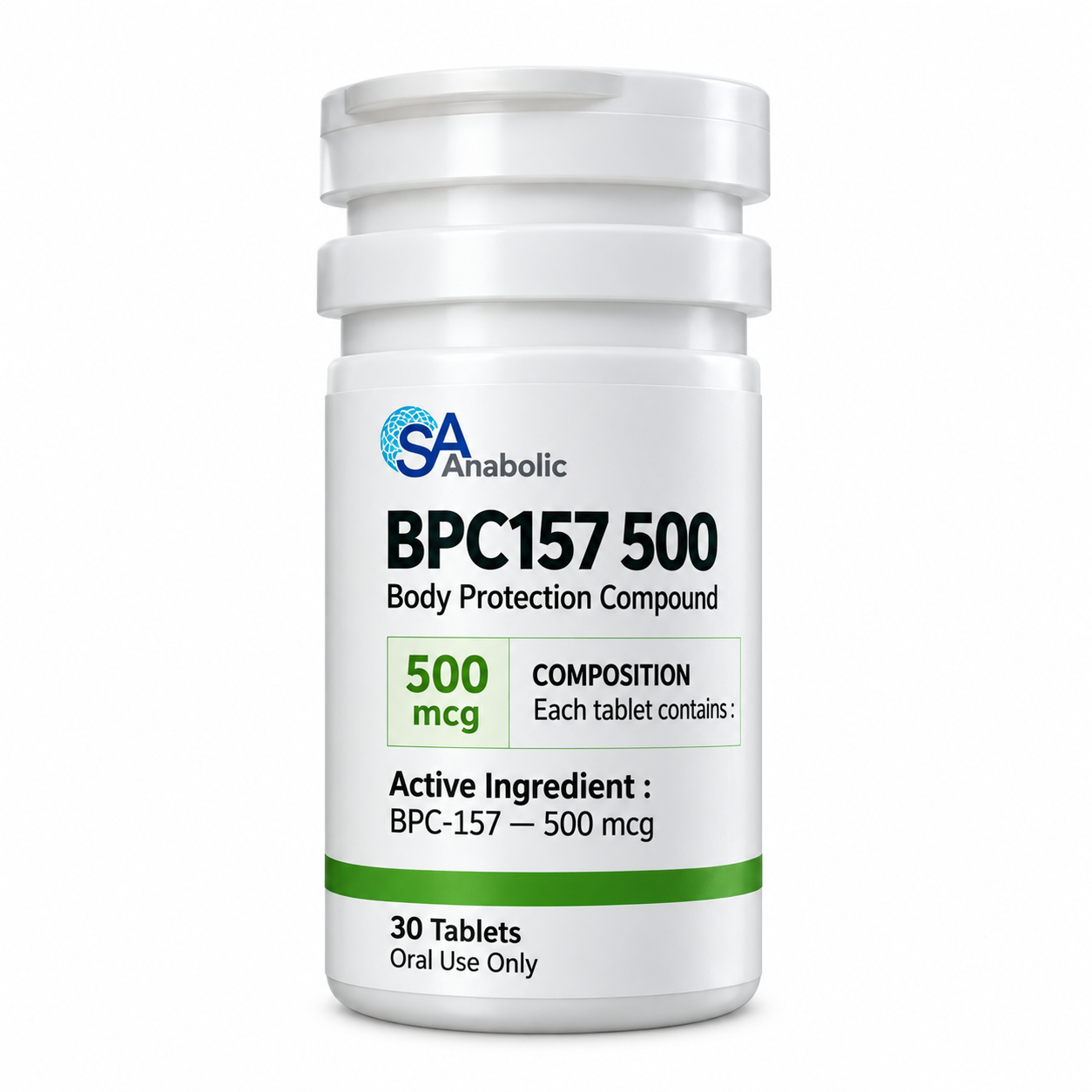
Injection findings do not establish oral-tablet outcomes
A 2021 retrospective knee-pain study followed 16 of 17 patients after intra-articular BPC-157, with or without TB4. Participants reported pain improvement, but there was no randomized comparator and this did not demonstrate anatomical tissue repair. It does not show that the pictured oral product repairs tendons. Read the primary knee-pain report
The FDA July 2026 assessment discussed an oral trial registry for which the reviewers had not found published results at that time. A registry or proposed formulation therefore does not establish absorption or treatment benefit for the pictured SA tablet. Read the July 2026 FDA assessment
Safety evidence also depends on the route of administration. FDA describes limited human information and concerns involving peptide impurities and immunogenicity for some routes. A side-effect list in an illustration should not be interpreted as comprehensive or proof that the product is generally safe. Read FDA safety information
This addition was reviewed on 1 November 2026. It does not validate a particular brand or product.
Additional oral-form and label questions
Has oral BPC-157 been proven to repair human tendons and tissues?
The evidence checked in this review does not establish those effects for the pictured oral tablet. Animal studies, intra-articular injections and intravenous administration do not directly establish absorption or clinical benefit for this oral product.
Is the 500 mcg shown in the image a recommended dose?
No. Here, 500 mcg is a transcription of the pictured label only. It does not verify actual content or recommend a dose, frequency or method of use.
Does the label illustration authenticate the product or its contents?
No. This is an AI-generated illustration derived from the supplied source image. It is not product-authentication evidence, a composition assay, a medicinal-product registration or a study of the SA product.