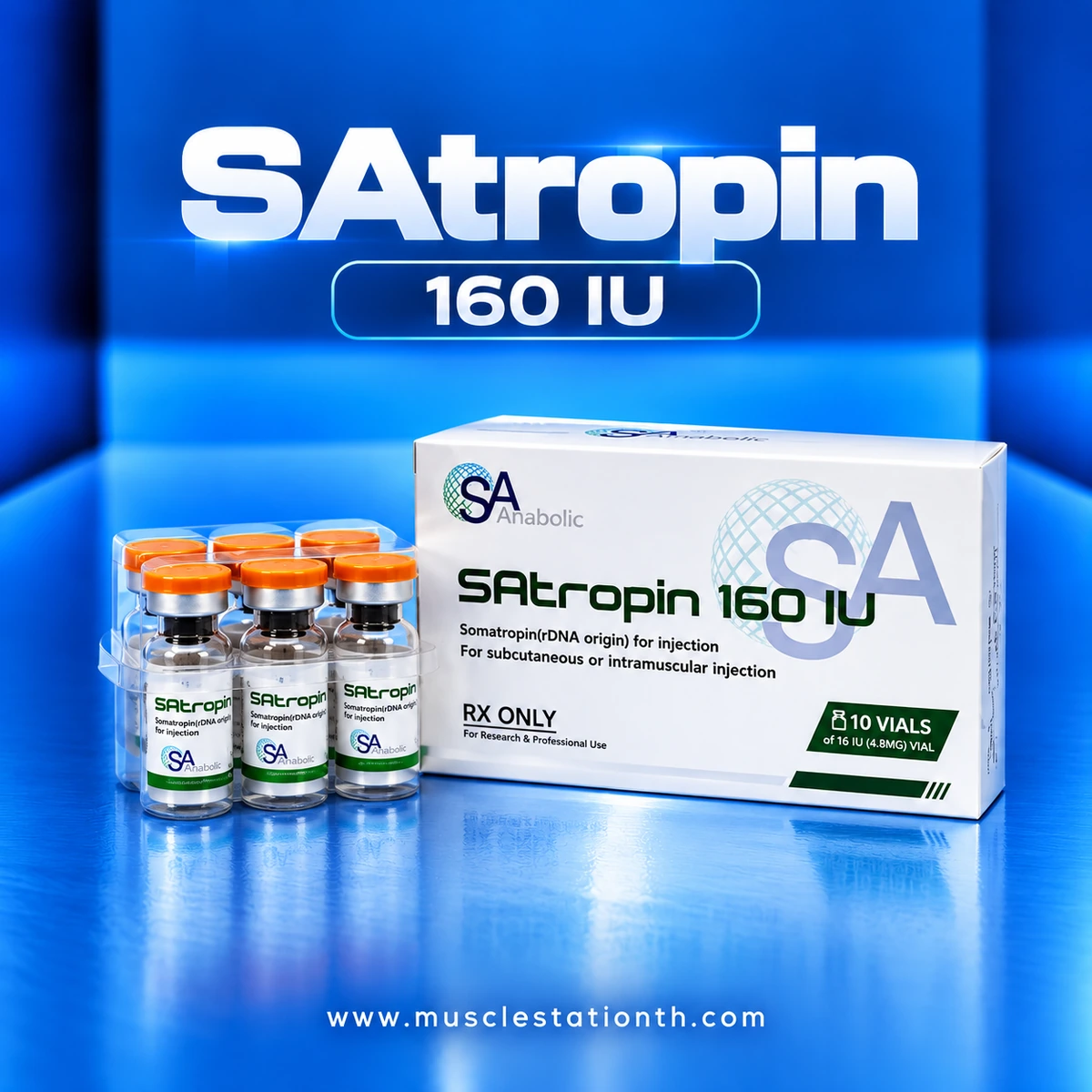
SAtropin 160 IU is the name shown in the supplied illustration. Official somatropin evidence provides medical context but does not verify SAtropin itself. Brand-specific evidence in this article remains UNKNOWN.
Brand name, active ingredient and an evidenced medicine
Somatropin is recombinant human growth hormone. EMA assessed Omnitrope, a named medicine; that assessment does not establish SAtropin equivalence. [H01]
This guide uses SAtropin 160 IU as an evidence-reading example. It does not authenticate contents, purity or registration. The supplied AI illustration is not a product test.
What benefits were measured, and in whom?
EMA evaluated growth in children with growth-hormone deficiency, using an Omnitrope–Genotropin comparison. [H01]
GENOTROPIN prescribing information reports randomized placebo-controlled trials in adults with growth-hormone deficiency. Body-composition findings included increased lean mass and reduced fat mass. Extending these results to healthy people or SAtropin requires additional evidence. [H02]
Read benefits alongside safety information
MedlinePlus lists muscle or joint pain and important symptoms such as visual changes or breathing difficulty that need medical assessment. These describe somatropin safety information, not SAtropin-specific adverse-event rates. [H03]
Assessing suitability involves diagnosis, medical history and other medicines. A number printed on a box cannot answer that clinical question. [H03]
How to read IU and packaging statements
Separate package total, amount per vial and vial count. Check whether the physical label and accompanying documentation agree. Here, 160 IU is text in artwork, not a measured quantity or an individual dose.
If records disagree, retain both statements with their provenance and mark SOURCE CONFLICT. Do not adjust numbers or derive unit conversions from the illustration to make it fit.
Keep verification questions separate
Before drawing brand-level conclusions, match product identity and documentation, the relevant country's regulatory record, and each study's tested product, population and outcome. Record missing verification as UNKNOWN rather than filling gaps by assumption.
A verification table should record the claim, original document, check date and unresolved question. Composition documentation and clinical outcome reports answer different questions. When new evidence arrives, update only the conclusions that evidence actually addresses.
Evidence table
If the table is wider than your screen, scroll it horizontally to read all columns.
| Question / status | Study design / scope | What the source supports | Limitations / unanswered questions |
|---|---|---|---|
| Growth evidence? VERIFIED — NAMED MEDICINE ONLY |
EMA assessment | Children with GHD [H01] | Not SAtropin |
| What supports body-composition findings? VERIFIED — NAMED MEDICINE ONLY |
Randomized placebo-controlled trials in prescribing information | Adults with GHD: body-composition changes [H02] | Not healthy adults or SAtropin |
| Where does safety information come from? VERIFIED — GENERAL MEDICINE CONTEXT |
MedlinePlus medicine information | Somatropin symptoms and precautions [H03] | No brand-specific risk estimate |
| Is SAtropin 160 IU verified here? UNKNOWN |
Scope of this article's source set | No brand-specific verification in this source set | Not proof of absence elsewhere or a legal conclusion |
Questions and answers
Does the same ingredient name prove brand equivalence?
No. Omnitrope's assessment does not establish SAtropin equivalence. [H01]
Does 160 IU specify how to use it?
No. Here it is illustration text, unverified against a physical label, and is not used to calculate a dose.
Can this article's evidence validate SAtropin?
No. These sources provide context for somatropin and named medicines; SAtropin-specific conclusions remain UNKNOWN.
Sources
- EMA: Omnitrope — overview and clinical assessment (2006 authorization; public overview updated 2018; product-information listing updated 2025, H01)
- DailyMed: GENOTROPIN prescribing information, section 14.1 (Current label accessed 2026-10-17; no revision year inferred, H02)
- MedlinePlus: Somatropin Injection (Current information accessed 2026-10-17; no revision year inferred, H03)
Sources checked: 2026-10-17. This article uses the listed evidence. It does not certify a brand or provide individual treatment advice.